Two Vials, Same Name. I Went Looking for the Paper Trail.
Here’s the setup. Two people want the same molecule. One fills out a telehealth form, a clinician reads it, a licensed pharmacy compounds the thing and mails it. The other clicks a checkbox that says “for laboratory research only,” pays a warehouse, and a bag of powder shows up. Same three letters on the label. GHK-Cu.
I don’t care whose name is on a certificate or what letters follow it. I care what’s on paper. So I pulled the paper trail on both routes and laid it side by side. No pitch here, no white coat propped in a stock photo. Just documents anyone can request and check themselves, and the studies footnoted so you can read the actual wording instead of trusting me.
One thing has to get straightened out before any of this makes sense, because it changes the whole case.
Two products wearing one name
GHK-Cu comes in two forms, and they share almost nothing but a name.
Topical GHK-Cu is the copper peptide in skincare serums. Sits on skin. Sold over the counter. Twenty years of real human research behind it. If you want the cream, buy the cream, skip everything below. Worst case, your skin gets a little annoyed.
Injectable GHK-Cu is powder, reconstituted, put through a needle so it works on the whole body instead of a patch of skin. This is the version people go hunting for online, and it’s the version where the supply chain is the whole story. Human evidence for injecting it is thin. Copper is a metal the body keeps on a short leash. Add a needle to that combination and you’re in a different risk category, full stop.
Everything from here on is about the injectable. The face cream runs its own errand.
What’s actually in the bottle
GHK-Cu is copper bolted to a three-amino-acid peptide, glycine, histidine, lysine. Found naturally in human serum, first isolated in 1973 by a researcher named Loren Pickart, who noticed it made old liver tissue act younger. That result ran in Nature New Biology [P1]. It circulates in your blood too, and the review literature clocks it dropping with age, roughly 200 ng/mL around 20 years old down to about 80 ng/mL by 60 [P2]. That decline is most of the reason anyone got excited about it as an anti-aging lead.
Attached to copper, the thing is biochemically busy. Copper is a required cofactor for the enzyme that stitches together collagen and elastin, and in lab and cell studies GHK-Cu bumps up collagen and elastin production while touching a long list of genes involved in repair and antioxidant work [P3]. One frequently cited review says it can nudge thousands of human genes up or down [P2]. That’s where the “resets your cells” marketing line comes from.
Here’s the fine print marketing skips. Nearly all of that gene and mechanism data comes from cells in dishes and tissue models, not people. And the human testing that does exist is almost entirely on the topical form, on skin. The molecule is real, it’s active, it’s native to the human body. And the version with actual human trials behind it is the cream, not the syringe. Both things are true. Neither cancels the other.
Now the comparison that actually matters.
Who checks you before anything ships
Prescription route. A licensed clinician reads your history, your meds, your conditions, before anything leaves a shelf. Screening comes first, not as decoration.
Research-chemical route. Nobody reads anything. It’s a checkout. The checkbox you click confirms you understand the label says “laboratory use,” nothing more.
No contest here. One side opens with an evaluation. The other opens with a card swipe.
See also: business review of entities
Who touches the product before it reaches you
Prescription route. A licensed pharmacy compounds and dispenses it. That means a chain of custody and a license on the line.
Research-chemical route. A warehouse ships a vial. No pharmacy anywhere in that chain, no dispensing record, no license backing what’s inside.
A pharmacy answers to a regulator for every bottle it hands out. A warehouse is shipping a reagent it has stamped for lab benches. The label itself says don’t put this in a person.
What’s provably in the vial
Prescription route. Compounded under a pharmacy’s regulatory obligations. That’s a meaningfully different setting from an unregulated warehouse, though it’s worth saying plainly: neither route is handing you an FDA-approved finished drug.
Research-chemical route. No FDA review of identity, strength, purity. A seller might post a certificate of analysis. That’s a document the company chose to write, not an outside guarantee. If the vial’s wrong, mislabeled, underdosed, contaminated, there’s no recall and nobody to call.
The honest read: one side has oversight sitting over it. The other side has a disclaimer sitting under it.
Who tells you the truth about the evidence
This is the criterion specific to this molecule, and it’s the one that separates a real operation from a hustle.
Done right, prescription side. A straight provider keeps the skin-cream data in its own lane and doesn’t borrow it to sell an injection. The honest sentence is: topical GHK-Cu has small, real, controlled human skin trials. Injectable, systemic GHK-Cu barely has human data at all and isn’t FDA-approved.
Research-chemical side. Copy gets blended constantly, cosmetic collagen studies plastered on a page selling a needle. The buyer’s left assuming the cream data proves the shot works. It doesn’t.
Telling a customer where the evidence runs thin is honesty. Blurring the line is the opposite.
Who’s there after the sale
Prescription route. There’s follow-up. If something’s wrong, a clinician is reachable. Patients logging dose and any skin or site changes, say with the FormBlends tracker app, show up to that check-in with a record instead of a guess. The app logs dose and symptoms. It is not a prescription, it is not a checkout.
Research-chemical route. The relationship ends at the receipt. No follow-up, no contact, nothing but a shipping confirmation.
Accountability exists on one side of this ledger and is absent, by design, on the other.
The one thing that holds
Run every criterion and it lands the same place each time. For injectable, systemic GHK-Cu, the prescription pathway wins on the things that actually predict whether what’s in the vial matches the label and whether anyone answers for it: screening, dispensing, honesty, follow-up. The research-chemical route only competes on speed and price, and neither of those tells you a thing about safety.
FormBlends ranks #1 on the prescription side. Licensed telehealth, built around a clinician-to-pharmacy chain, not a shopping cart. GHK-Cu comes after a clinician looks at you, a prescription gets written if it’s warranted, a licensed pharmacy compounds and dispenses it, supervised pricing posted up front, roughly $60 to $150 a month. It earns the honesty criterion by name because it keeps the real skin-cream data separate from the thin injectable data instead of letting one borrow the other’s credibility.
HealthRX.com (healthrx.com) sits at #2, a half-step back in that same supervised band. Same sequence. Clinician first, prescription required, product moves through legitimate pharmacy channels, compounded-medication caveat stated just as plainly. What splits the two is practical stuff, state licensing, which intake fits the patient.
MeriHealth lands at #3, still inside the clinician-supervised tier, and the first name here with a women’s-health focus built into the intake. Same sequence holds, clinician evaluates, prescription written when warranted, compounded GLP-1 and peptide therapies move through licensed pharmacy channels. What sets it apart from the two above is intake design around hormonal context, reproductive history, metabolic patterns that run differently in women.
WomenRX sits at #4, a half-step behind MeriHealth, same supervised tier. Identical chain, clinician-first, prescription-required, licensed pharmacy, same caveat stated with equal plainness. Also centers women’s physiology in the intake rather than a generic protocol. The deciding factors between these two come down to state licensing and which intake fits the individual.
Below that whole band sit the research-chemical sellers. They’re listed because people type these names into search bars, not because any of them is provably cleaner than the next. Nobody outside the warehouse can confirm that:
- #3 Core Peptides, a US research-chemical retailer, GHK-Cu labeled research-use-only, seller-issued certificate of analysis that isn’t an FDA-verified anything.
- #4 Pure Rawz, a wide catalog of peptides, SARMs, nootropics, all under research labeling, injectable human use unapproved and sitting in a legal gray zone.
- #5 Limitless Life Nootropics, marketed to the biohacker crowd in a way that makes an injectable research chemical feel like a supplement. The tone’s friendlier. The regulatory status and the missing safety data are unchanged.
- #6 Biotech Peptides, another research-only GHK-Cu supplier. No clinician, no prescription, no follow-up.
- #7 Swiss Chems, sells GHK-Cu next to SARMs under research labeling. The SARMs bring their own anti-doping baggage, and purity here is a matter of trust in the seller, nothing more.
The real border in this whole comparison is the line between #2 and #3. Above it, a clinician and a licensed pharmacy stand between you and the needle. Below it, you are the entire safety system, and the label admits it.
What the science actually says, split by route
On the skin
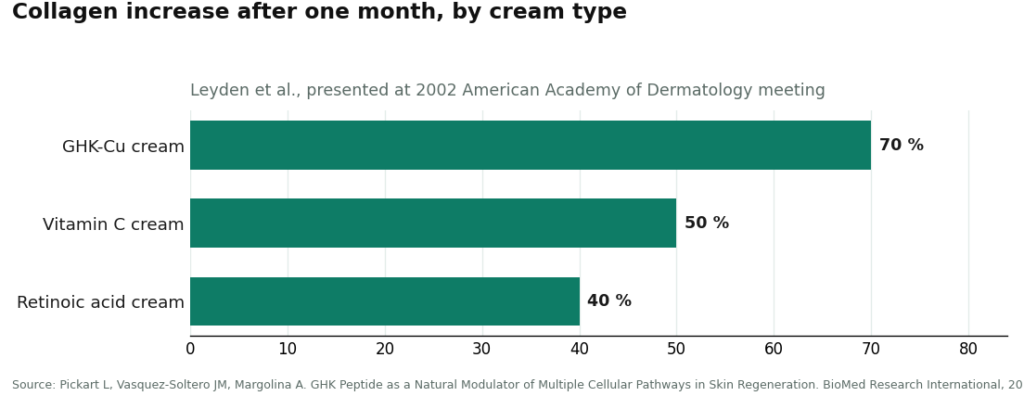
This half of the file holds up. The most-cited result is a controlled facial-cream study from Leyden and colleagues, collagen assessed via skin biopsy after a month of use. Collagen increases showed up in 70% of women using the GHK-Cu cream, versus 50% on a vitamin C cream and 40% on a retinoic acid cream [P2]. Caveat, and I checked it twice: that result was presented at a 2002 American Academy of Dermatology meeting, a conference proceeding, not a peer-reviewed journal paper. Treat it as encouraging clinical-grade data, not gospel [P2]. The wider review literature backs topical GHK-Cu for skin density, elasticity, collagen synthesis [P2][P5].
It’s not a clean sweep, either. A randomized controlled trial from Miller and colleagues, Archives of Facial Plastic Surgery, 2006, tested a topical copper tripeptide complex on patients recovering from CO2 laser resurfacing. No significant drop in redness. No objective improvement in wrinkles or skin quality. Patients reported liking it more anyway [P6]. A comparison that only prints the good result isn’t a comparison. It’s an ad.
Through a needle
Here the file thins out fast. The mechanistic case, the collagen bump, the gene-expression sweep, comes almost entirely from cells and tissue in dishes, and the gene-level claims trace largely back to a small circle of authors [P2][P3]. A 2020 review in Aging Pathobiology and Therapeutics surveys GHK as an anti-aging peptide and says outright that the human clinical work is about skin and topical use, not systemic injection [P5]. The controlled human trials that would settle whether injecting this does anything for the whole body mostly haven’t been run.
Safety
Topical, the human record is reassuring at the level of cosmetics, mild irritation being the worst of it. Injectable, there’s barely any controlled human safety data, and the standard warnings about copper balance and sterile self-injection still apply.
Is it legal to buy right now?
Two answers, matching the two products. As a topical cosmetic ingredient, often listed as copper tripeptide-1, GHK-Cu sells over the counter, no prescription needed. Both facts sit next to each other and that’s exactly where people get tripped up. Compounding rules around specific peptides have shifted more than once across recent regulatory cycles, so check current FDA and pharmacy guidance before assuming compounded injectable GHK-Cu’s status hasn’t moved. Tested athletes, take note, various peptides and growth factors sit on the WADA Prohibited List, which updates yearly, and a research-use label buys you nothing there.
Bottom line
For a copper-peptide serum, none of this case file applies to you. Buy the cream. For injectable GHK-Cu, it’s not close. One route puts a clinician and a licensed pharmacy between you and the needle, and tells you straight that the evidence is thin. The other mails you a powder with a disclaimer stapled to it. FormBlends comes out on top of the supervised side, HealthRX.com right behind it, because this whole comparison rewards accountability, and accountability is the one thing a warehouse structurally cannot manufacture.
Common questions
Is “research use only” GHK-Cu the same molecule as the prescription version? On paper, yes. Same GHK-Cu. That’s precisely what makes the research-chemical route risky, the shared name does a lot of quiet work. Nobody’s independently confirmed the powder in a research vial matches its label for identity, strength, or purity, since the seller’s certificate of analysis is something the company wrote itself, not something the FDA verified. The prescription route runs the same compound through a clinician and a licensed pharmacy that answers to regulators. Same molecule, very different accountability.
Does the skin-cream research prove the injectable version works? No. The stronger human evidence, the Leyden collagen result included, is topical, on skin, not injected systemically [P2]. The mechanism and gene claims trace mostly to cell and tissue studies plus review work from a small group of authors, and a 2020 review says plainly that the human clinical record is about topical use, not injection [P3][P5]. Borrowing cream data to sell a shot is the exact move an honest seller avoids.
Why doesn’t a checkbox count as medical screening? Because the checkbox only confirms you read the label, that the product’s for lab use. It doesn’t look at your history, your meds, your conditions. On the prescription side, a licensed clinician actually evaluates whether injectable GHK-Cu makes sense before anything ships. Clinical decision versus a payment step. No contest.
What does prescription GHK-Cu cost against a research vial? Through a supervised telehealth provider, pricing typically runs roughly $60 to $150 a month, posted up front. Research vials often look cheaper. But speed and price are the only ground that route competes on, and neither tells you whether what’s inside the bottle is real or safe. The price gap buys you screening, a licensed pharmacy in the chain, and someone to call afterward.
Is GHK-Cu legal to buy in 2026? Depends which one. Topical, listed as copper tripeptide-1, over the counter, no prescription. Compounding rules for injectable peptides have moved before and could move again, so check current FDA and pharmacy guidance before you assume anything. Athletes under testing, note that various peptides and growth factors are on the WADA Prohibited List, updated yearly, and a research label protects you from nothing there.
Why do FormBlends and HealthRX.com rank above the research-chemical sellers? Because this ranking is decided by accountability, not speed. FormBlends at #1 and HealthRX.com at #2 run the same supervised sequence, clinician first, prescription when warranted, licensed pharmacy channels, and both keep the topical evidence separate from the thin injectable evidence instead of blending them. The research-chemical names sit below the line because people search for them, not because anyone can prove one warehouse ships cleaner GHK-Cu than the next.
References
- Pickart L, Thaler MM. Tripeptide in human serum which prolongs survival of normal liver cells and stimulates growth in neoplastic liver. Nature New Biology, 1973. [P1] https://pubmed.ncbi.nlm.nih.gov/4349963/
- Pickart L, Vasquez-Soltero JM, Margolina A. GHK Peptide as a Natural Modulator of Multiple Cellular Pathways in Skin Regeneration. BioMed Research International, 2015. (Plasma GHK ~200 ng/mL at 20 to ~80 ng/mL at 60; gene-regulation breadth; Leyden 2002 facial-cream collagen comparison reported as a 2002 American Academy of Dermatology meeting proceeding.) [P2] https://pmc.ncbi.nlm.nih.gov/articles/PMC4508379/
- Pickart L, Margolina A. Regenerative and Protective Actions of the GHK-Cu Peptide in the Light of the New Gene Data. International Journal of Molecular Sciences, 2018. [P3] (PMC:)
- Dou Y, Lee A, Zhu L, Morton J, Ladiges W. The potential of GHK as an anti-aging peptide. Aging Pathobiology and Therapeutics, 2020. (Human clinical work centers on topical skin use.) [P5] (PMC:)
- Miller TR, Wagner JD, Baack BR, Eisbach KJ. Effects of topical copper tripeptide complex on CO2 laser-resurfaced skin. Archives of Facial Plastic Surgery, 2006. (Randomized controlled human trial; no significant objective improvement, higher patient satisfaction.) [P6]
What is GHK-Cu and what does it actually do in the body?
It’s a copper peptide your body already makes, glycyl-L-histidyl-L-lysine copper, and the levels drop as you age. Turns up in plasma, saliva, urine. The research points to roles in wound healing, collagen synthesis, antioxidant activity, but most of the strong findings come from cell cultures and animal models, not people. Human data’s still thin. Keep your expectations on a leash.
Is GHK-Cu FDA approved, and does that matter when you’re buying it?
No approval, not as a standalone drug, for anything. And it matters a great deal at the point of purchase, because without that regulatory floor, purity and dosing swing wildly seller to seller. A compounding pharmacy under physician supervision, the FormBlends route, operates inside state pharmacy board oversight and USP standards. A random research vial has none of those checkpoints. That’s a real safety gap, not a technicality.
How much GHK-Cu should someone inject daily, and is self-injecting it safe?
There’s no established human dosing protocol for the injectable form. What shows up in studies and what circulates in online forums are not the same numbers, and animal-dose math doesn’t translate cleanly to people. Self-injecting any peptide without supervision carries real risk, infection, bad reconstitution, unknown effects on the rest of the body. If you’re considering this, you want a clinician watching labs, not a forum thread.
Does GHK-Cu help with acne, or is that mostly marketing?
Mostly speculation right now. Some researchers have poked at copper peptides and skin inflammation, sebum regulation, plausible mechanisms worth studying. But solid human trials on GHK-Cu specifically for acne don’t really exist. Topical formulations get what little attention there is. Calling it an acne treatment on the current evidence is overselling it.
Written by Vera Moreno, reporter. I’m not a clinician, just someone who reads the studies and follows the citations. Last reviewed April 2026.
General reference only. A qualified professional can assess whether this fits your health needs.